Rhinestone tiara
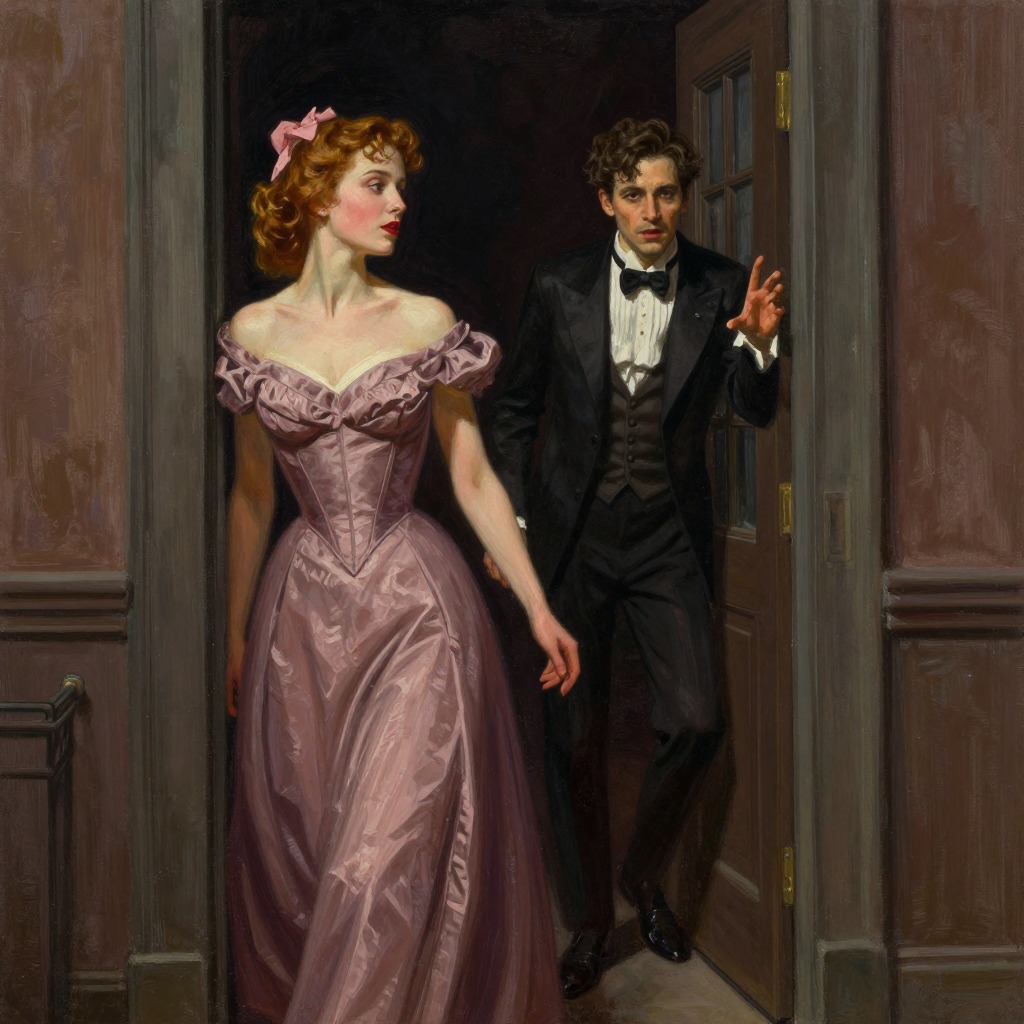
The rhinestone tiara is a piece of costume jewelry that Blanche DuBois wears in the final scenes of Tennessee Williams's A Streetcar Named Desire. It is not a genuine diamond crown but a cheap imitation—Stella identifies it as "a rhinestone tiara she wore to a costume ball" , and Stanley later sneers that it is a "worn-out Mardi Gras outfit, rented for fifty cents from some rag-picker" . The tiara crystallizes Blanche's central conflict: her need to present herself as a queenly, refined figure in a world that relentlessly exposes her as a fraud.
Appearance and Material Nature
The tiara is first mentioned in Scene Two when Stanley ransacks Blanche's trunk and pulls out what he calls "diamonds! A crown for an empress!" . Stella corrects him, explaining it is merely a rhinestone tiara she wore to a costume ball, and when Stanley asks what rhinestone is, Stella replies, "Next door to glass" . The object is thus established from the start as a piece of theatrical illusion—something that looks valuable but is essentially worthless. Later, in Scene Ten, Blanche places the tiara on her head before the mirror of the dressing-table, murmuring excitedly as if to a group of spectral admirers . When Stanley sees her, he asks sarcastically, "And come up with that—gorgeous—diamond—tiara?" , and Blanche defensively calls it "This old relic? Ha-ha! It's only rhinestones" . The tiara's cheapness is a direct analogue to Blanche's own pretensions: she tries to pass herself off as a woman of breeding and wealth, but the truth is always visible beneath the glitter.
Symbolic Function in Blanche's Final Crisis
The tiara reaches its full symbolic weight in Scene Ten, when Blanche, having been drinking steadily since Mitch left, decks herself out in a soiled white satin evening gown and scuffed silver slippers, then places the rhinestone tiara on her head . She is preparing for a fantasy—a cruise of the Caribbean with the imaginary millionaire Shep Huntleigh—but the reality is that she has no telegram, no millionaire, and no escape. Stanley brutally strips away her illusions: "And look at yourself! Take a look at yourself in that worn-out Mardi Gras outfit, rented for fifty cents from some rag-picker! And with the crazy crown on! What queen do you think you are?" . The tiara, which Blanche had used to crown herself as a queen of romance and refinement, becomes the emblem of her degradation. It is the costume of a queen who has no kingdom, the crown of a woman who has been deposed by the brute facts of her past.
Connection to Blanche's Trauma and Self-Fashioning
The tiara is part of a larger pattern of objects Blanche uses to construct a protective fantasy. She covers the naked light bulb with a paper lantern, sprays herself with expensive perfume, and wears clothes that suggest a life of leisure and luxury. The tiara is the most extravagant of these props—a literal crown that declares her royalty even as her circumstances prove her poverty. This self-fashioning is a response to the trauma that haunts her: the suicide of her young husband Allan Grey, whom she discovered in a homosexual encounter and then publicly humiliated, leading him to shoot himself at Moon Lake Casino . The polka tune "Varsouviana" that played at the casino returns in her mind during moments of stress , and she drinks to escape it. The tiara, like the paper lantern, is an attempt to control how she is seen—to replace the unbearable truth of her past with a beautiful lie. But as Stanley's mockery makes clear, the lie is as fragile as rhinestone, and it shatters under the light of reality.
The Tiara as a Carnivalesque Object
From the perspective of carnivalesque theory, the tiara enacts a grotesque parody of coronation. Blanche places it on her head in a private ritual of self-aggrandizement, but the crown is fake, the ceremony is solitary, and the kingdom is a two-room tenement in the French Quarter. Stanley's mockery—"What queen do you think you are?"—is a form of decrowning, the ritual reversal that carnival demands. The tiara, which Blanche uses to elevate herself, becomes the instrument of her humiliation. It is a thing that, in its cheapness and theatricality, exposes the gap between her self-image and her actual condition. The object's materiality—its rhinestones, its paste, its origin in a costume ball—insists on the performative nature of Blanche's identity, and on the violence with which that performance is shattered.